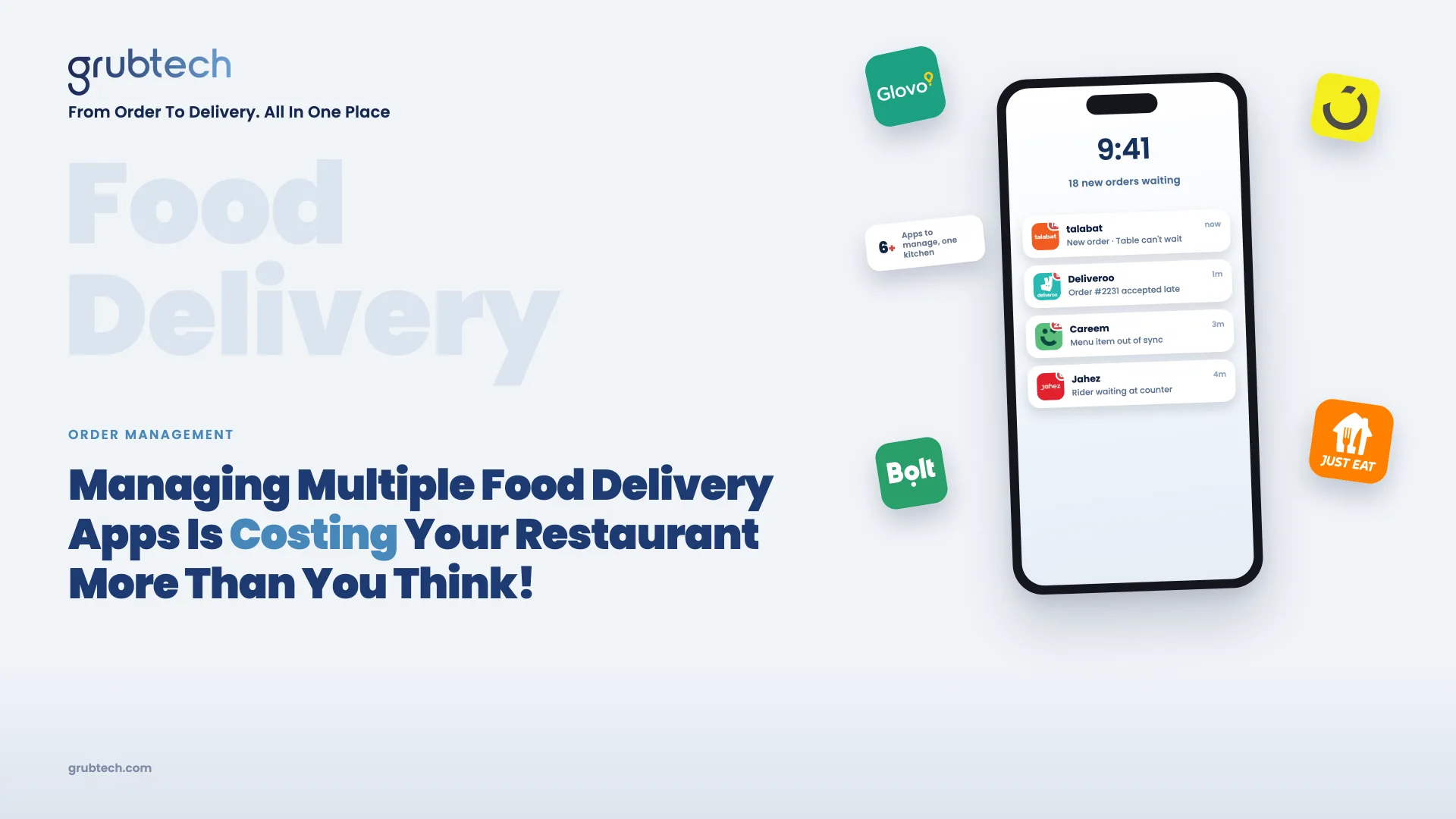
Managing multiple food delivery apps is one of the most common operational headaches in restaurants today, and one of the least talked about. Not because it's rare. Because it's become normal.
It's Friday evening. The kitchen is running hot. Four tablets sit on the counter: one for Talabat, one for Deliveroo, one for Uber Eats, one for HungerStation. Three are beeping. One went quiet twenty minutes ago.
Nobody noticed. Somewhere, a customer is watching their order freeze at "preparing." The food was fine. The review won't be.
This is the five-tablet problem. And it's not really about the tablets. It's about the architecture behind them.
What is the food delivery tablet problem in restaurants?
How do restaurants end up managing so many delivery tablets?
The five-tablet problem describes a setup most restaurants fall into by default: one physical device per delivery platform, each operating independently, each requiring separate logins, separate menu management, and separate monitoring during service.
It wasn't a strategic decision. It was the fastest way to go live on each new aggregator. For a single location running two platforms, it worked well enough. The problem compounds when restaurants expand to more delivery platforms, more locations, or both. What starts as a manageable workaround becomes a structural drag on operations that affects staff, kitchen output, customer experience, and margin.
The more delivery platforms a restaurant adds without a unified layer, the more operational complexity grows. Not linearly, but exponentially.
The real cost of managing separate food delivery apps in your restaurant
How much does managing multiple delivery platforms actually cost a restaurant?
The visible damage is easy to identify: a missed order, a menu item still showing as available after it sold out, a delivery marked from the wrong platform. These are costly, but they are the surface.
The deeper cost of fragmented food delivery app management runs across four areas:
1. Staff attention pulled from operations
During peak service, your team monitors four screens instead of running four stations. Every tablet check during a rush is attention taken from the kitchen and the customer.
2. Menu inconsistency across delivery platforms
Updating a price or marking an item as sold out means doing it four times in four apps with four different interfaces. Miss one update on one platform and the refunds follow.
3. No unified delivery performance data
Each aggregator generates its own report in its own format. Understanding actual delivery performance means combining data manually, and most operators don't have time for that.
4. Slow and expensive multi-location onboarding
Every new location recreates the same fragmented setup from scratch: four accounts, four tablets, four training sessions, four points of failure.
How a unified restaurant order management system solves the delivery app problem
How do I manage all my food delivery apps in one place?
A unified restaurant order management system, also called a restaurant middleware platform, sits between all delivery aggregators and the rest of the restaurant's technology stack. It receives orders from every platform, normalises them into one standard format, and routes them to the kitchen as a single flow.
In practice, this is what changes:
1. One kitchen queue for every delivery platform
Orders from Talabat, Deliveroo, Uber Eats, HungerStation, Keeta, and Glovo arrive in one kitchen queue, regardless of platform. The kitchen display system shows one unified view. Staff work one flow.
2. One menu update reaches every platform
Menu updates push to every connected delivery platform simultaneously. One change in one place. No missed platforms, no inconsistency, no refunds for items marked available on one app and unavailable on another.
3. Unified delivery performance reporting
Delivery performance reporting consolidates automatically. Operations managers see a single view of order volume, delivery times, rejection rates, and revenue across every aggregator, every location, in real time.
4. Faster onboarding for new locations
New locations onboard faster. The configuration replicates rather than rebuilds. A new branch goes live on all active delivery platforms without recreating the setup from scratch.
The tablets may still be there. But they stop being the thing that runs the operation.
Why food delivery app management gets harder as your restaurant scales
How do multi-location restaurant groups manage delivery platforms across branches?
At a single location, experienced staff absorb the gaps in a fragmented delivery setup. The inefficiencies exist but stay hidden inside the effort of the people carrying them.
At ten locations across multiple markets, each running different aggregator configurations, different menu versions, and different reporting setups, that compensation breaks down. Every new platform added multiplies the problem across every location.
Restaurants using centralised food delivery management systems consistently report measurable gains in order accuracy, staff efficiency, and delivery performance. More importantly, they can add new aggregators and new locations without adding proportional operational overhead.
Across 16,000+ live locations in 28+ countries, grubtech connects 350+ integration partners, including every major food delivery aggregator in the region, into a single restaurant order management flow.
More delivery platforms should mean more revenue, not more tablets
The five-tablet problem is not inevitable. It is the result of adding delivery platforms without the infrastructure to manage them together. And it is solvable.
The restaurants that scale delivery operations without losing control are not the ones with the fewest platforms. They are the ones that stopped managing platforms separately and started managing orders as a unified flow: one operational layer, every aggregator, no gaps.
More platforms should mean more revenue.
Not more tablets.
```